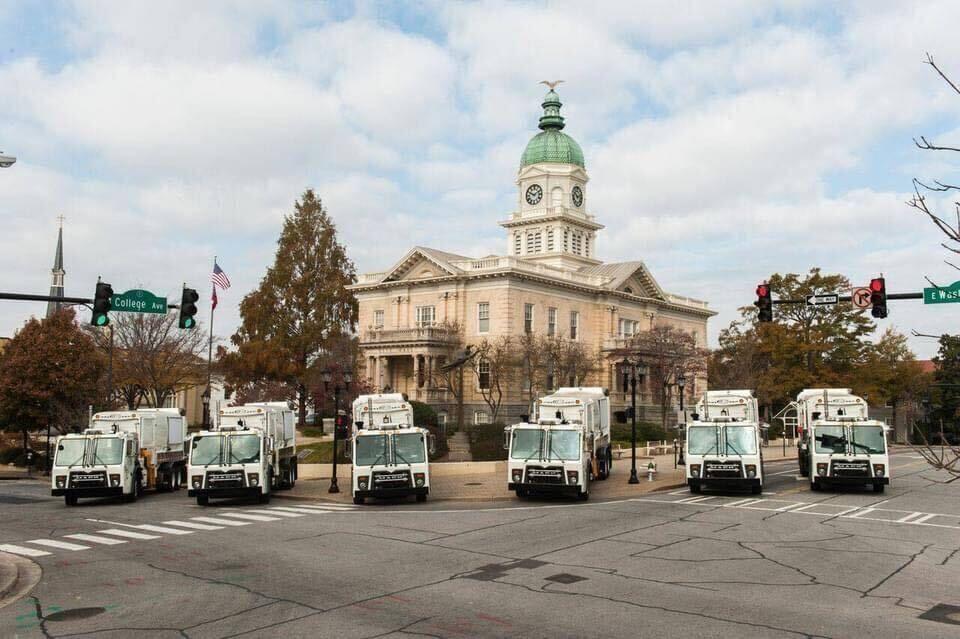
The Athens-Clarke County Solid Waste Department and the University of Georgia’s New Materials Institute have partnered together to introduce a Residential Compost Pilot Program to residents in the Normaltown and Boulevard Districts of Athens-Clarke County.
Sponsored by a grant from the Walmart Foundation, the Residential Compost Pilot Program is expected to run from Jan. 29 through May 10, 2024. A total 400 residents of the Normaltown and Boulevard District of Athens-Clarke County registered for the program with the goal of diverting some of their waste to compost. The program’s goal is to prevent microplastics from entering the environment and to see how much education exists around composting.
“We are seeing what a larger scale compost collection residentially would look like for us to see how people would do,” Suki Janssen, the Solid Waste Department Director for Athens-Clarke County, said. “At the end of this pilot, or towards the end, we’ll be surveying all of these participants to see what they would be willing to pay for this.”
Currently, the pilot program is free for participants through the help of the sponsorship from the Walmart Foundation. After the program concludes, Janssen hopes to gather an understanding of the feasibility of implementing a permanent compost program in the region of Normaltown. Janssen noted that there are many costs to consider when composting, including the cost of trucks, workers and compost carts.
A few years ago, a sponsor contacted UGA’s New Materials Institute trying to navigate how to introduce composting to cities of various sizes. The institute identified three mentor cities of different sizes and sought expertise on implementing a compost pilot program in a city like Athens.
Janssen emphasized that the practice of reducing and reusing is preferable to traditional landfill disposal and aims to minimize the environmental impact associated with waste management.
The items that pose the most problems in landfills managed by the county’s solid waste department generate landfill liquid leachate and hazardous gasses, such as methane. Methane, a potent greenhouse gas, can pose a significant fire hazard in concentrated amounts, and leachate management can also be costly for landfill programs.
Moreover, commonly used plastic garbage bins can harm the environment due to their material polyethylene composition.
“Every time you bring them to the edge of the street, they deposit microplastics because they’re made out of durable plastics that don’t compost and basically stick around for a long time,” Evan White, director of the Biosentiac Laboratory at UGA’s New Material Institute, said.
White said the institute sought an alternative solution that would not contaminate the waste stream and address the problems with the end-of-life of some materials.
“You don’t want to recycle a landfill plastic then because it will smell like landfill after you recycle it,” White said.
The program is expected to conclude May 6-10, when the compost roll-carts will be collected from participants. Janssen hopes that the pilot’s potential success will lead to program expansion over time and urges people to recognize the importance of our current decisions for future generations.
“The bigger differences are going to be realized once we start manufacturing things that are on the front end,” Janssen said. “And that’s a more global effort than what we do as just opinions.”
Context: This story was completed during my time as a contributor for student-led newspaper, The Red & Black, in Athens, Georgia. Click below to see the original publication.

