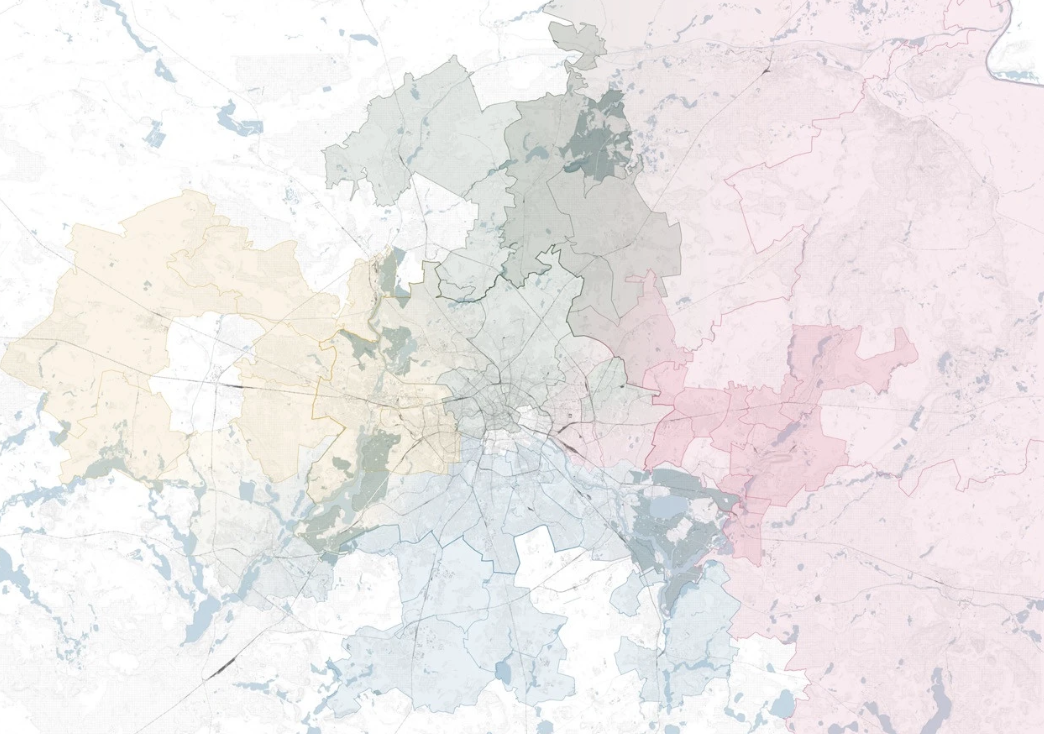
The Berlin-Brandenburg Municipal Neighbourhood Forum (KNF) is a voluntary alliance of cities, lands, and districts across Berlin and Brandenburg. Its mission is to harmonise the objectives of its members, amplify the voices of economically disadvantaged regions, and foster a united regional identity and vision.
Their core mandate is to streamline processes, particularly large scale initiatives, and to strengthen collaboration across member jurisdictions. Over a 14-month period, TSPA, together with bgmr and RHA, developed a forward-thinking conceptual vision for KNF. We worked to cultivate cross-border cooperation across the Berlin metropolitan area and establish a shared framework for future priorities.
Our contribution takes shape in a theoretical vision plan: a strategic roadmap featuring proposals and case studies designed to guide KNF’s future work and inform coordinated action.
Understanding Municipal Planning in Germany
Although Germany’s federal system empowers municipalities with autonomy in building and planning, it also has its limitations. Unlike many nations, Germany lacks strict zoning codes but the real challenge lies in land ownership. Many cities and districts, even within the Berlin region, lack sufficient reserves of developable land. This creates bottlenecks for densification and new housing projects.
KNF provides an innovative solution to these issues: a platform for inter-municipal discussion and resource sharing. When one municipality lacks land while a neighbour holds surplus capacity, the forum becomes the center for negotiation, effectively acting as a land-use “trade floor” for collective benefit. Development undertaken in one area inevitably radiates advantages throughout the region.
Annual Themes and Strategic Vision
As an umbrella network, KNF connects 47 municipalities across Berlin and Brandenburg, with a clear focus on metropolitan Berlin. Each year, the forum prioritises thematic areas and recently, this has included traffic, transportation, and water management. Given the numerous water bodies in and around Berlin, as well as the tourism potential they present, KNF has been particularly focused on how to develop and maintain these assets sustainably.
The recurring question is how do we translate shared ideas into concrete action?
This is where TSPA stepped in. Collaborating with a Berlin-based landscape architecture firm and a strategic urban planning office from Dortmund, we co-designed a vision plan around four key pillars for the next two decades:
- Connectivity – Seamless interlinking of transport, infrastructure, and networks
- Beauty and Landscape – Elevating aesthetics and preserving natural ecosystems
- Resilience – Strengthening adaptability to environmental, economic, and social challenges
- Balanced Region – Promoting equitable development across jurisdictions
Project Timeline
From April 2024 to June 2025, the 14-month initiative unfolded in sequential phases such as defining strategic aims, benchmarking best practices, and analysing instructive case studies.
Initially, KNF itself was uncertain of its core mission, which was in fact a key contributor for the project’s start. However, our role helped catalyse internal reflection and resurface critical questions that had previously been overlooked.
Challenges and Results
Coordinating a forum with diverse actors, each representing different constituencies and agendas, was the project’s primary challenge. While all members shared a common overarching goal, their priorities and interpretations often differed.
Thanks to the neutral facilitation of KNF’s management board, all seasoned experts adept at bridging the gap between multiple perspectives, we were able to identify shared ground. The outcome was a coherent, inclusive vision that aligned with the varied interests of all stakeholders.
Ultimately, the process proceeded smoothly, culminating into a clear and positive outcome. The next pivotal step now lies in implementing the strategic vision.
What Comes Next
For TSPA, this marked our most significant Berlin-based collaboration in recent years, a milestone we embraced enthusiastically. Despite typical inter-institutional dynamics, the partnership itself was both productive and conceptually rigorous.
Moving forward, success now depends on KNF’s ability to operationalise our recommendations, translating strategy into tangible actions. We anticipate this vision becoming increasingly outward-facing, with real impact across the greater Berlin-Brandenburg region.
Context: This story draft was completed during my time as an intern with Berlin-based urban planning and design company, TSPA. Click below to view the official publication.

